

Live 3D bottle
A fully procedural three.js bottle (frosted-glass vessel, spun bronze cap, 150 instanced capsules visible through the frost) in one persistent canvas. Static-shot fallback when WebGL or motion isn't welcome.
Case study · Product · Brand site
An operator-built premium supplement brand. The waitlist site had to read as a fully-operating DTC (bottle-led motion, dose-disclosed editorial, a $49 founder tier capped at 500) before a single capsule shipped.
Live 3D
A procedural bottle rendered in the browser, scrubbed by scroll
6 + 3
Dose-disclosed ingredients on the panel, no proprietary blends
500
Founder-tier reservation cap, visible from the hero
0
Urgency timers, coupon codes, or fake testimonials
The product
IntelVit is a single-SKU nootropic brand for ambitious operators: a mushroom-led daily capsule packed in a frosted-glass cylinder with a bronze cap. The v1 site is the product: every section reads like the supplement-fact label, every scroll moment earns its place, and the waitlist is the only place a buyer can convert before the first batch ships.
Product in action
Screenshots from the IntelVit site: the July 2026 'The Site Is the Label' redesign, rendered in the brand's own Forest Studio system (cream paper, olive eyebrows, bronze doses) and embedded here so this reads as a real case study, not an abstraction.
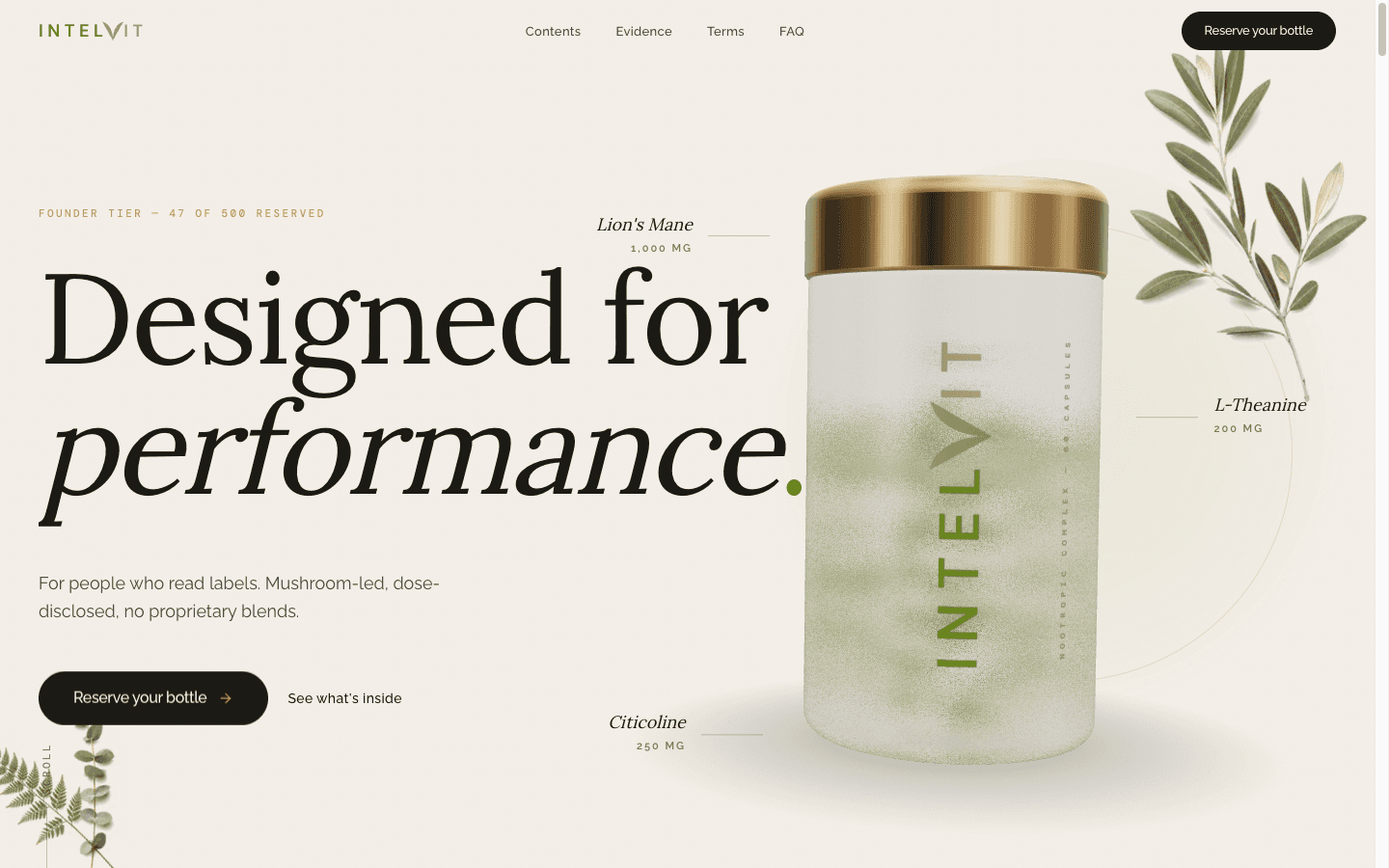
Moment 1 · Hero
The frosted-glass bottle is a real-time three.js render, not a photo, and the milligrams are annotated right on the hero. No stock photo, no robot brain, no gradient mesh.
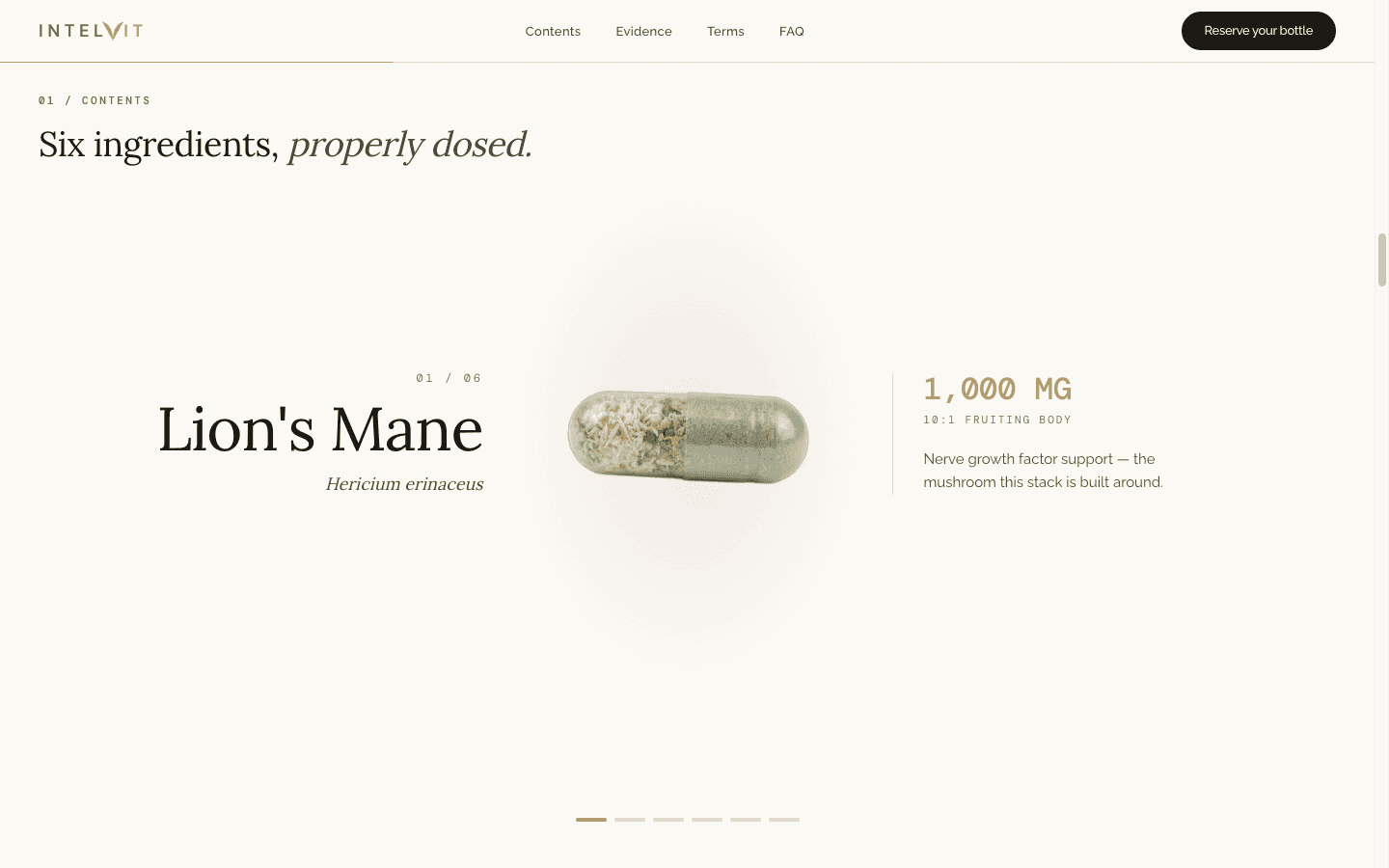
Moment 2 · Contents
Six chapters, six doses, each at the level the research actually used: name in serif, dose in bronze mono, mechanism in one sentence. This is the page label-readers screenshot and send to a friend.
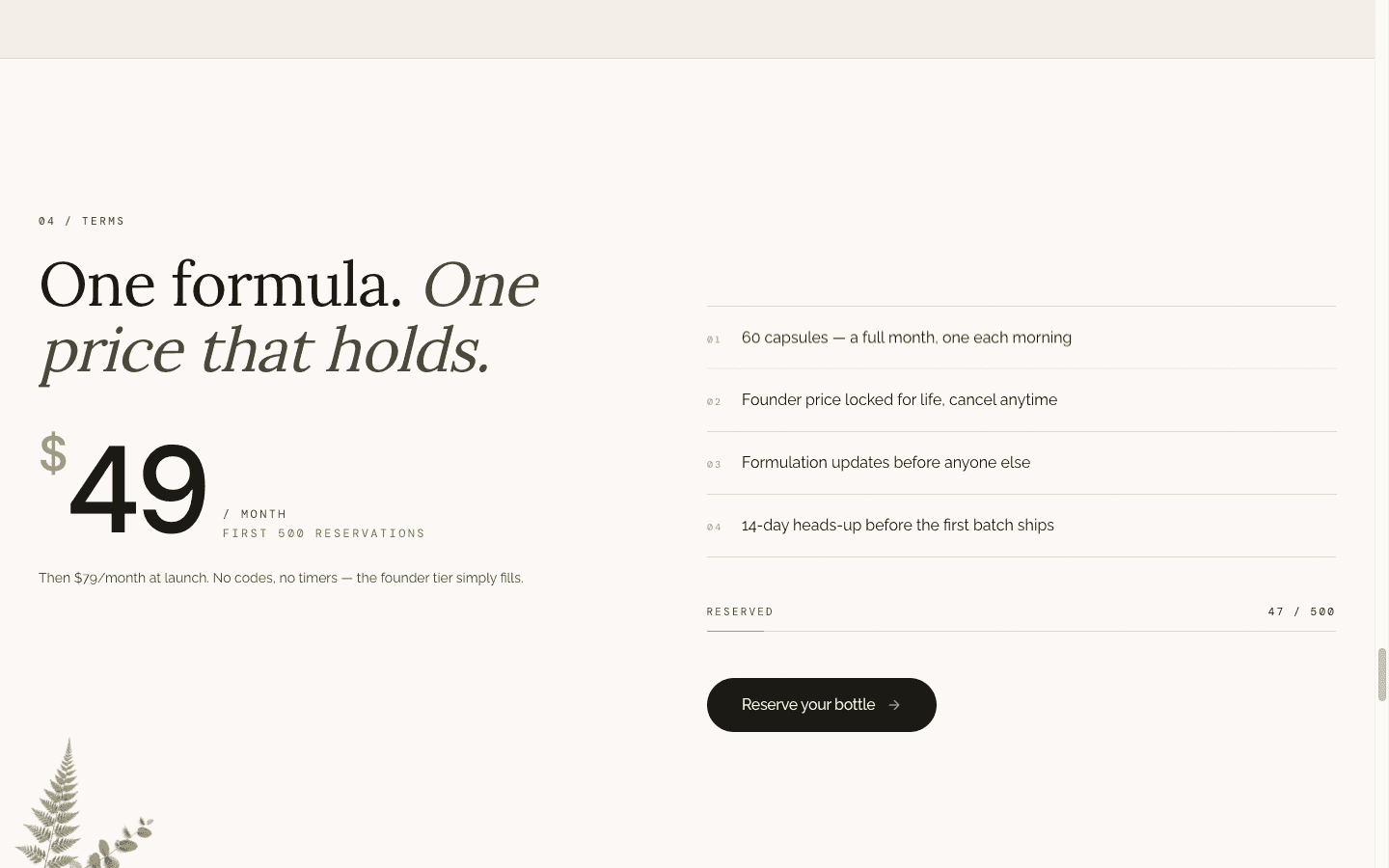
Moment 3 · Terms
$49 a month for the first 500, locked for life. $79 a month after launch. The cap is real, the reservation bar is real, and there isn't a single urgency timer on the page. Trust scales when you stop using dark patterns.
The problem
Most nootropic brands market like 2014 wellness DTC: pastel gradients, urgency timers, influencer mosaics, and a marquee ingredient buried at a tenth of the dose the research actually used. Label-readers see through it in seconds. Operators do too.
IntelVit was founded by someone who actually takes the stack. The brief was unambiguous: the site has to read like the panel. Every milligram named. No proprietary blends. No countdown clocks. And it had to do all of that while still selling like a premium DTC brand to a buyer who has never bought a nootropic before.
Category sites lead with pastel gradients and influencer grids, none of which match a label-reader's frame.
Pre-launch DTC means no commerce backend day one. The waitlist has to be the product, without sounding like vaporware.
Most launches lean on urgency theater (timers, fake counts, limited-offer banners). IntelVit wanted the opposite: visible scarcity, named numbers, no dark patterns.
What we shipped
Each one ships in the current build. No flagged-off sections, no placeholders for things we never built.
A fully procedural three.js bottle (frosted-glass vessel, spun bronze cap, 150 instanced capsules visible through the frost) in one persistent canvas. Static-shot fallback when WebGL or motion isn't welcome.
Each of the six nootropics gets a dossier chapter: serif name, binomial, milligrams in bronze mono, mechanism. No 'proprietary blend' anywhere on the page.
Scroll unscrews the cap along its thread and sends capsules arcing out of the bottle: Lenis smooth scroll on the GSAP ticker, driving the same live 3D scene as the hero.
Peer-reviewed citations on a deep-olive full-bleed: study, dose, journal, year, for the exact doses in the capsule. Picked from peer review, not press releases.
$49 founder tier with an odometer count-up and a live reservation bar; the $79 launch price disclosed in the same breath. No coupon codes, no urgency timers, no 'request a quote.'
Email capture wired to Loops with idempotent handling, type-safe form action, soft-fail in dev, inline success and error states. No client-side state library.
How we shipped it
IntelVit was built the same way every IB Digital engagement runs: a principal engineer owning every decision, AI tooling speeding up the implementation, every section reviewed against the brand brief. V1 runs on Next.js 16 + React 19, with Tailwind 4 CSS-first tokens so the Forest Studio palette lives in one place.
And it keeps evolving: in July 2026 the site was rebuilt ground-up as 'The Site Is the Label', a dossier-numbered one-pager wrapped around a live procedural 3D bottle, with Lenis + GSAP scroll choreography and react-three-fiber rendering. It shipped as a single release, in the same AI-native workflow as v1.
The result is heavy where it needs to be (a real-time 3D product, scrubbed scroll scenes, multi-chapter editorial) and quiet where it doesn't. The waitlist is a single server action; analytics is one client-side init; the email pipeline is one Loops API call. Production primitives, no toy libraries.
01
Every section built in the same workflow we run for clients. Tight feedback loops on copy and layout, not weeks of slide reviews. Voice rules, banned-word lists, and palette tokens enforced at the file level.
02
GSAP + Lenis for the scrubbed open scene and masked line reveals; the live three.js bottle in one persistent canvas with adaptive quality tiers. A hard rule that nothing animates layout dimensions, and reduced motion always gets a settled page.
03
Server actions for the waitlist, Loops for email nurture, PostHog for conversion analytics, Vercel for deploys. The pre-launch site ships like a commerce site, ready to flip on Shopify the day the bottles arrive.
The outcome
Pre-launch DTC is a trap: most brands ship a placeholder splash page and call it a waitlist. IB Digital shipped the opposite. Every panel reads like the supplement-fact label, every scroll moment earns its place, and the founder-tier reservations started filling the same week the site went live.
Let’s talk
No slide deck, no discovery call fee, no ‘request a quote’ games. We’ll tell you whether it’s a fit in the first call — and point you somewhere useful if it isn’t.